
This teaching and learning initiative responds to calls for universities and communities to share and co-create knowledge to contribute to the development of socially and environmentally conscious students. Undergraduate community engagement opportunities are widely regarded by academics and practitioners as representing one of the most transformational forms of learning for students. International fieldwork experiences, in particular, enable geography students to practically apply theoretical and conceptual ideas in confronting and complex learning contexts. As such, we model a curriculum that values intercultural collaboration and the inclusion of diverse perspectives by connecting students with the expertise and experiences of people beyond the academy.
Each year the Discipline of Geography and Sustainability at UOW offers a two-week international cultural immersion fieldtrip, where social science students engage with, and learn from, local community-based experts.
- In 2017 and 2018, students focused on the interconnections between social and ecological change, culture and tourism working with local Balinese hosts to understand how individuals and community-based organisations are responding to social inequalities and environmental challenges. In Bali, Indonesia, students are learnt about bird conservation, coral reef rehabilitation, plastic pollution, community-based tourism and to learn about dance, music and culture.

- In 2019, 2020, 2023 and 2024, I worked with Dakshin Endeavours to took facilitate the travel of 20 UoW students to the Western Ghats, one of the world’s biodoversity hotspots.Here students engage with people with different knowledges, lived experiences and expertise. Our Indian partners link students up with conservation practitioners, researchers, NGOS, government officials, academic community, civial society practitioners, and Indigenous knowledge holders where they learn about human-animal conflict, the complexities of conservation, and Indigenous sovereignty and land rights
I endeavor to model a curriculum that values intercultural collaboration and the inclusion of diverse perspectives and see value in connecting students with the expertise and experiences of people beyond the academy.
Rather than endorse a ‘do-gooder saviour’ approach or Kontiki tour type experience I promote social justice oriented education and respectful and ethical engagement with people and places through tourism that draws on the expertise, ideas and skills, live experiences of diverse knowledges and community partners.
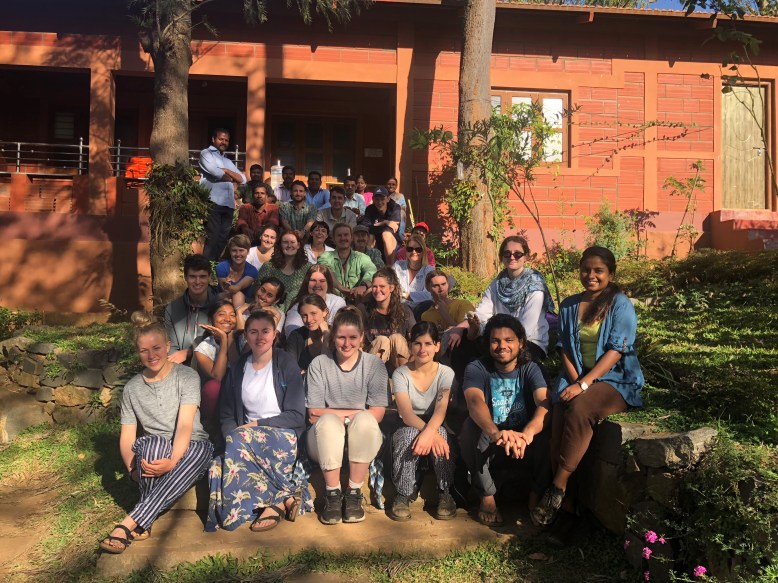
Taking an experiential learning approach, fieldtrips embed embodied, collaborative styles of learning, and encourage students through creative assessments to develop intercultural competence and global awareness, communication skills, critical self-reflection and techniques for situated learning and functioning in a team.
Student and academic reflections from reflective journals, field notes and informal focus groups indicate that embodied learning in cross-cultural contexts, underpinned by listening, sharing and exchanging ideas, enable students to gain a greater awareness of issues of power, wealth, and ethnicity that operate within a complex set of economic, political, environmental and cultural dynamics shaping how we see, think and do. The pedagogical and transformative potential arises because students are challenged to think deeply about their own social positions and to recognise how intimately connected they are to the issues they encounter.
 laurahammersley